
What Are The Best Alternatives To Letter Grades In Education?
Originally published May 14, 2018. Updated April 10, 2026.
Few artifacts of formal learning are as iconic as the letter grade.
What can I do to get an A?
She’s a C student.
He’s always gotten As and Bs.
She has a 4.0 GPA.
Letter grades are deeply familiar to students, families, teachers, colleges, and schools. That familiarity matters. It is one reason they have endured for so long, even when they reduce learning to a single symbol that often communicates far less than people assume.
The problem is not that families are wrong to want clarity. They are right to want it. The problem is that a letter grade often creates the appearance of precision without actually explaining what a student understands, where they are improving, what still needs work, or what should happen next.
Teachers looking for alternatives to letter grades are usually not looking for something abstract. They are looking for ways to communicate learning more honestly, support revision, reduce distortion caused by averages and points, and make student performance more visible over time. Some alternatives do this more directly than others.
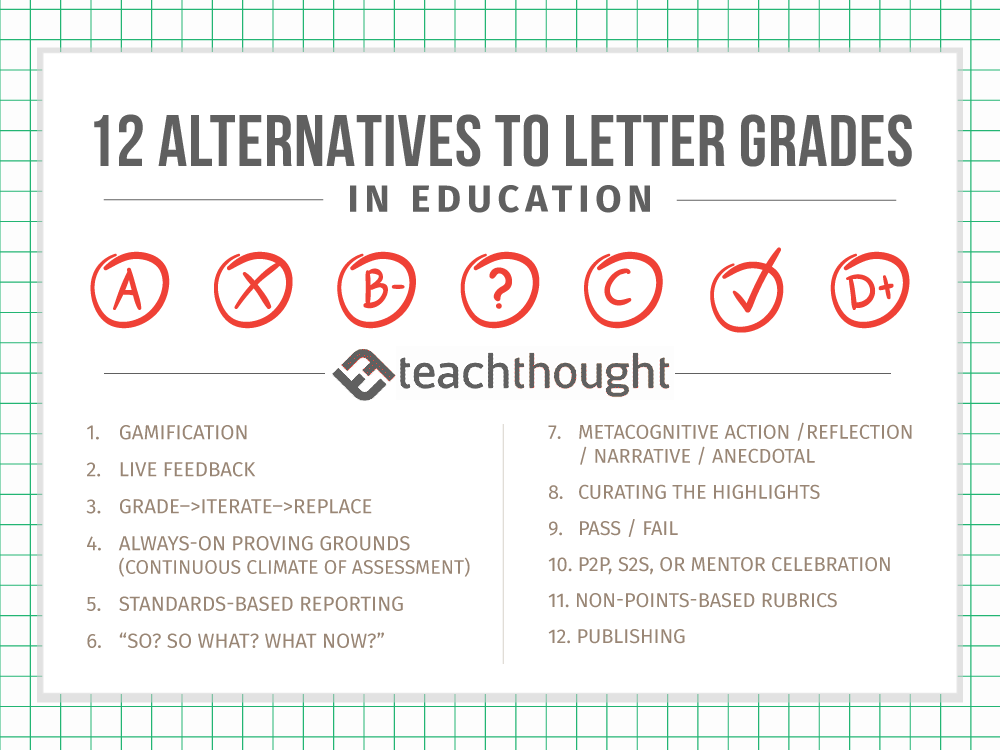
Below are 12 alternatives to letter grades. Some are realistic replacements schools can implement now, such as standards-based reporting, non-points-based rubrics, digital portfolios, and feedback-centered revision.
Others work better as complementary structures that strengthen assessment without fully replacing a reporting system. Taken together, they suggest a broader idea: grading does not have to depend on a single letter to be clear, rigorous, or useful.
In practice, the strongest alternatives are usually the ones schools can adopt without replacing their entire reporting system at once: standards-based reporting, non-points-based rubrics, digital portfolios, structured reflection, and feedback-driven revision.
In practice, the strongest alternatives are usually the ones schools can adopt without replacing their entire reporting system at once: standards-based reporting, non-points-based rubrics, digital portfolios, structured reflection, and feedback-driven revision.
Other approaches, such as gamification, publishing, and peer collaboration, may still be valuable, but they usually work better as supports for assessment than as full substitutes for grades.
See also 15 Alternatives To Report Cards
The Failure of the Letter Grade
The letter grade fails because one its primary functions–to communicate learning results to learners and families—cannot possibly be performed a single symbol.
Further, the letter grade ‘pauses’ learning–basically says that at this point, if I had to average all of your understanding, progress, success, and performance into a single alphanumeric character, it’d be this, but really this is over-simplifying things because learning is messy and understanding is highly dynamic and perishable.
But parents don’t want to hear about understanding because it’s grey area that doesn’t make sense. It sounds like spin. It’s subjective. Complex. They want it to be distilled for them–and rightfully so, but that reduction dissolves the honesty of the learning process. Conversations with parents turn most frequently on missing work, learner temperament and/or attendance, or the letter grade. Rarely does it explore the value or utility of knowledge, creative thinking or curiosity, or even the crucial ability to evaluate information or apply and transfer what’s been learned.
So that leaves education in a tight spot. Parents need capacity as bad as the education system itself.
While standards-based grading is one attempt to reduce how subjective letter grades are–measure and report proficiency based on standards as ‘grades’–this is only a step in the right direction. Here, at least parents know what a grade is based on, but they still don’t know any more about what their son or daughter understands.
The ideal ‘response’ here isn’t a single change, but a total merging of schools and communities. But until that happens, there are options.
Which Alternatives To Letter Grades Are Most Realistic?
For most teachers and schools, the most practical alternatives are the ones that can fit within existing systems rather than replace them all at once. Some approaches function as direct alternatives to letter grades, while others work better as complementary structures that improve how learning is assessed and communicated.
| Alternative | Best For | Main Strength | Main Limitation |
|---|---|---|---|
| Standards-Based Reporting | Schools seeking clearer reporting tied to specific learning goals | Shows what students know and can do more clearly than a single averaged grade | Can be difficult to implement consistently across classes or districts |
| Non-Points-Based Rubrics | Teachers who want more descriptive evaluation without overhauling everything | Keeps attention on quality, criteria, and performance rather than raw points | Still requires careful calibration to avoid vagueness or inconsistency |
| Digital Portfolios | Showing growth over time, especially in writing, projects, and creative work | Makes progress, revision, and authentic work visible | Can become time-intensive without clear routines and expectations |
| Narrative Feedback / Live Feedback | Classrooms focused on revision, conferencing, and formative assessment | Gives students actionable information instead of a symbol | Can be hard to sustain at scale without efficient systems |
| Pass / Fail | Limited contexts where completion or basic proficiency matters more than ranking | Reduces false precision and can lower performative pressure | Provides less detail unless paired with stronger feedback |
| Self-Assessment & Reflection | Building metacognition and student ownership | Helps students interpret their own progress and next steps | Works best as part of a broader system, not as a standalone replacement |
| Gamification, Publishing, Peer Collaboration | Increasing engagement, audience, and feedback loops around learning | Can make learning more visible, social, and motivating | Usually strengthens assessment rather than replacing a grading model on its own |
12 Alternatives to Letter Grades
1. Gamification
This idea has never really found traction in most public school classrooms, but a comprehensive system of badges, trophies, points, XP, achievements, gamification can help clarify the nuance of learning. Such an approach–with all of its tools and tactics and systems–is capable of far more resolution and precision than a letter. For starters, here are 10 strategies to make learning feel more like a game.
2. Live Feedback
Here, students are given verbal and written feedback immediately–as work is being completed. Live scoring without the scoring and iteration. No letters or numbers, just feedback.
Make an audio recording of the event. Or video. Livestream it. Make it a ‘podcast’ ( but private–so an audio file, basically) for parents to listen to with their child on the drive to school each morning. Live feedback for critical learning objectives is difficult and not sustainable for every assignment but is far more enlightening for all stakeholders, and thus a valid alternative to the letter grade in spots.
3. Ungrading
Grade–>Iterate–>Replace: In this process, work is graded as it traditionally has been, then, through revision and iteration, is gradually improved and ultimately curated. Eventually ‘lesser’ performance (as determined by students, peers, families, and teachers) is replaced by better work, but without the grades.
Grades simply jump-start the revision process and that’s it.
4. A Continuous ‘Climate of Assessment’
In this model, assessment never stops–the result of one assessment is another. Not tests but demonstrations. It doesn’t stop, so rather than halting the process to assign a letter, the process continues on.
In this ‘climate of assessment’ what would be reported would instead be achievements, trends, strengths, areas for growth, pace of change, and so on. This could be directly connected to gamification (see #1).
5. Standards-Based Reporting
This one replaces letters with numbers, so it’s really not much better but it can reduce the subjectivity of grading.
6. “So? So What? What Now?”
Here, students are asked–and ask themselves–at the end of every assignment–So, So What? What Now? This is similar to #4 above, but leaves the next step up to the student. Okay, you’re ‘finished’ with this work. Now:
So: What did you ‘do’? Summarize details and big picture
So What? Why was this work important?
What now? What is the logical next step with this assignment, idea, or topic?
7. Metacognitive Action/Reflection/Narrative/Anecdotal
This approach dovetails behind #6. Rather than halting the learning process with a letter-as-performance-indicator, instead, learners are tasked with reflecting on their thinking process–not as a patronizing ‘tell the teacher what they want to hear’ activity on an exit slip walking out the door, but as a measure of their understanding and intellectual growth.
This can be based on metacognition, reflective on the progression through the content, or more anecdotal about the learning process itself.
8. Digital Portfolios
A variation of the reflective and anecdotal approach, curating the highlights amounts to the student and teach getting together to extract the highlights of an assignment or the process of project-based learning. Portfolio-based work isn’t new–and has its drawbacks as well, namely that specific skills and competencies are difficult to measure objectively.
There is also significant subjectivity evaluating these kinds of projects. It can bs stressful, is difficult to match with standards, and often centers the teacher instead of the student if not done well (meaning the teacher is tasked with designing, assigning, managing, organizing, grading, etc.–and that’s no efficient or fair).
No single model solves every grading problem, and each approach comes with tradeoffs. The better question is not which alternative is perfect, but which one communicates learning more clearly and supports the kind of classroom a school is trying to build.
9. Pass/Fail
No letter grade–you either pass or fail. Not a great solution to anything other than the shades of grey between an A and a D, but an alternative nonetheless.
10. P2P, S2S, or Mentor Collaboration
Gather with peers within and across schools to celebrate academic and learning success. No grades necessary–just planned visibility from the start of the project with diverse groups of peers. Peer response can also be embedded throughout a lesson or unit by design, rather than only at the end as a summative evaluation.
11. Non-points-based Rubrics
This is much like the current systems–student performance is still evaluated against a rubric, but not grade or points are ever assigned. It is up to the student and their family to determine ‘how they did.’ The goal of the teacher is not to grade students, but rather to support learners. Students will wiggle and writhe trying to turn the rubric’s assessment into a letter grade, and that’s fine.
As a teacher, you’ve moved on to taking data from that performance to plan the next steps.
12. Publishing
This one was hinted at above–when appropriate, make the learning public. Publish it.
Note, this doesn’t have to threaten student privacy. Consult your principal, colleagues, and parents if you’re unsure but such publishing can be anonymous if necessary. The goal is that it’s visible to families, peers, and communities for whom the work will resonate.
Peers can collaborate on revisions, families can respond, communities can celebrate or scoff, but the process has been decentralized and, in a way, democratized. This approach won’t work for every student every time, but the idea is sound–return the stakeholding to the stakeholders. This approach is likely only useful in certain situations
Also consider: trends over time, improvement based on time/content, etc., visual resumes, peer assessment, grading backward (this isn’t exactly an alternative to letter grade but is a different approach to grading using existing tools/grades)
Ed note: This post was originally published in November of 2012 and has been updated several times, most recently in 2026